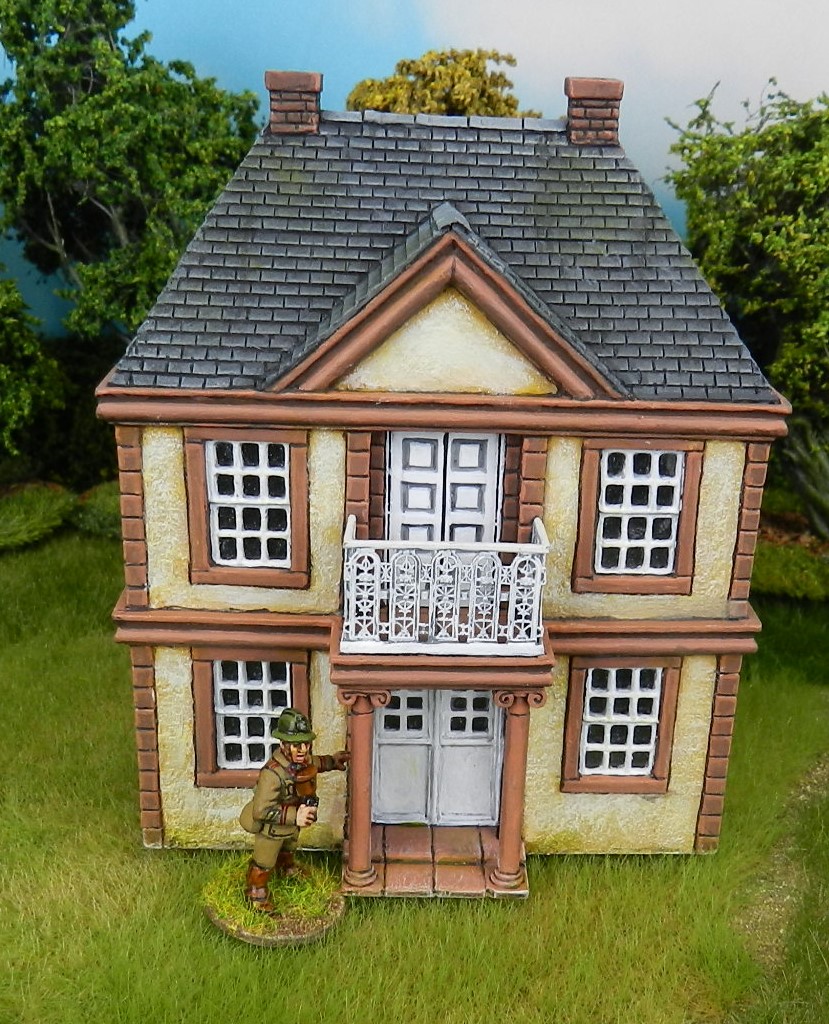
Having posted images now of most of the terrain I built years ago, here is my most recent effort, completed only a couple of weeks ago. It is part of a project to provide terrain for games set in the Franco-Prussian War of 1870-71. A sub-project within that greater one is to build several small chateau-type buildings. Most FPW battlefields had one or two such places, and they feature in the accounts as strongpoints being stormed at bayonet point. One battle (Coulmiers) actually had no less than six chateaus on it, but some of them were subsumed within villages so don't necessarily need modelling specifically. I decided three chateaus would cover things. Here's the first and I'm currently hard at work on the second.
I have long fancied making something in the French chateau line, as they are such nice buildings, deliberately intended to be pleasing and varied in appearance and in the larger cases impressive, with elaborate and stylish architectural features. Things being what they are of course, this desire rather clashes with the ground scale I tend to use, whereby a whole large battlefield is compressed onto a medium sized wargames table. For example in my FPW rules one inch equals a hundred metres, so a single building, even a big one, might scarcely be one inch square on its own!
But where there's a will there's a way. Studying the layout of these places I find they come in successive layers. You have the actual chateau building, but that's surrounded by an area of stables and courtyards, which in turn is enclosed within a "zone" of walled orchards and gardens several hundred metres in area. The whole thing was fought over in reality. (An example most wargamers will be familiar with is the chateau/ farm of Hougoumont at Waterloo.) I decided that I could make a nice building in my usual "condensed" style, representing the whole zone without doing too much violence to strict ground scales.
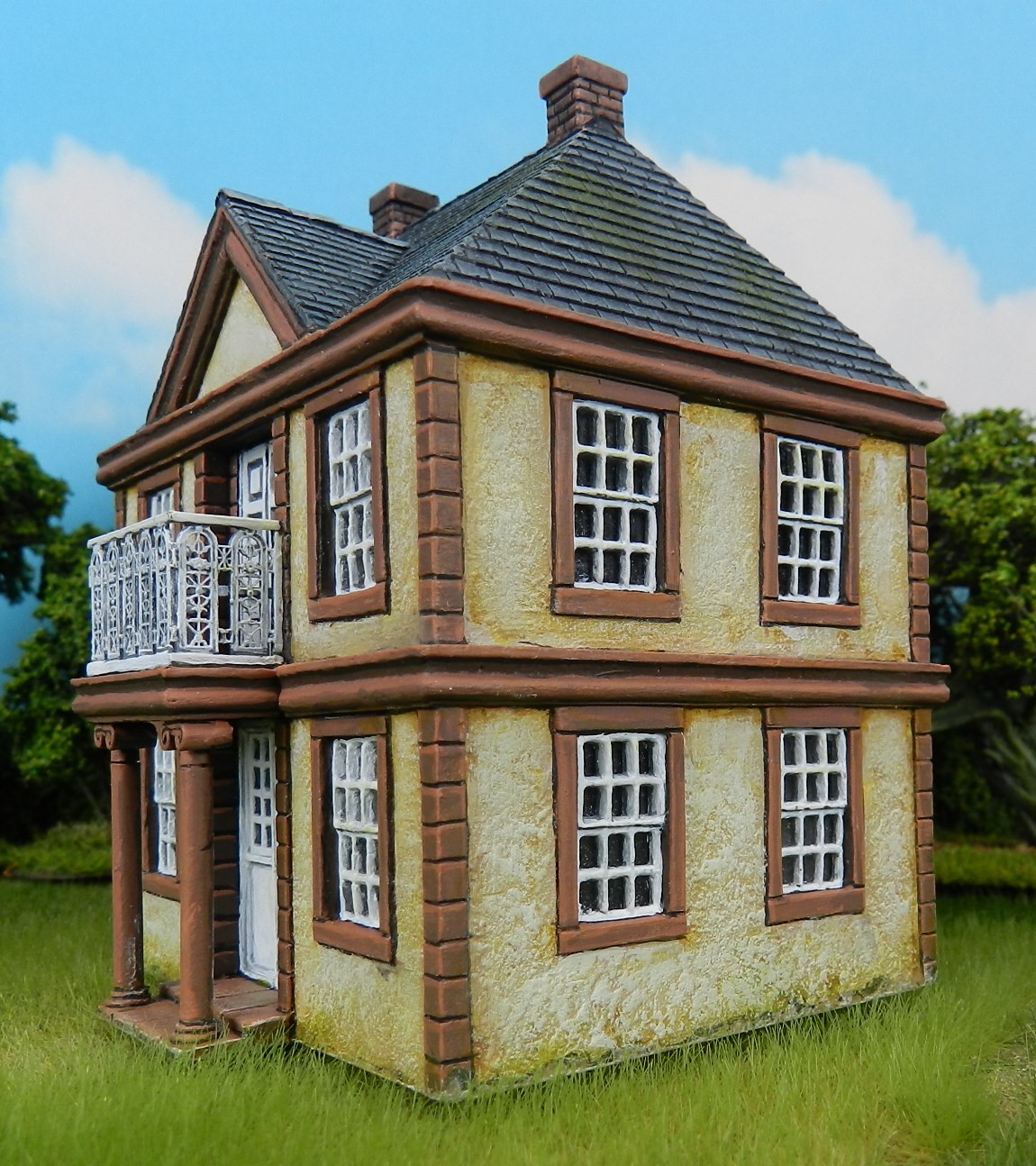
So off I went, starting with the smallest and simplest of the three chateaus planned, as something of a warm-up for the other two, which will be more elaborate. This one is in a gently neo-classical style, inspired by the Chateau of Duerckheim which stood in the village of Froeschwiller on the battlefield of that name (the one called Woerth by the Germans).
The model has come out pleasantly enough, I hope, considering how small it is. It's made from all sorts of materials: sheet card and styrene, dolls' house mouldings, scratch-built details and parts that have been lurking in my bits box for decades. It would take forever to describe how everything was made, but please feel free to ask about any of the aspects you are wondering about.
In this second photo I have included a figure to show the scale. Not having any singly based Franco-Prussian figures at this point, it's had to be a 1940 one. The building is suitable for the late seventeenth century up to WWII, although the elaborate balcony railings suggest the nineteenth century onwards. Incidentally those railings are styrene 1/48 model railway details from the American firm of Grandt Line, now San Tuan Details. I reinforced the delicate castings with styrene rails on top and behind, and I think it should stand up to normal gaming use.
In terms of colour I decided to break away from my customary grey-brown stonework, and go for a pinky-brown sandstone. I used dark brown paint, highlighting up to a dark flesh colour. It makes a change at any rate, and goes nicely with the cream rendered walls.
From the back you can see the scratch-built doors more clearly. Front and back doors are identical, and it would have been a good idea to build just one and take castings. But I didn't have anything to make a mould with at the time I did this model, something that's had to be addressed for the next model.
I painted a lichen effect on the tiles, which has come out OK if a bit understated. I'm going to go for a more drastic overgrown effect on at least one of the other chateau models.
Here we see just how small this model is, when placed next to the improved-MDF equivalent featured a few months ago. Of course both are strictly speaking more what the French would call a "maison bourgoise", or a "maison de maitre" rather than a chateau in size terms. But these are the compromises we have to make for wargaming purposes. The bigger one here is aimed at skirmish gaming, where a somewhat more "literal" scale of scenery is called for.
And finally, the size contrast is shown fully here. If you look at the previous picture you will see that the height difference is quite small, in order for both to look acceptable with the figures used. But the ground area is very different. The mini chateau is just 90mm by 70mm so the area taken up is only a third of the larger version. In fact if you take account of the projecting areas the contrast is still greater.







0 Yorumlar